Understanding it managed services pricing is critical for businesses evaluating whether to outsource IT infrastructure, security, and support. In 2026, managed service providers (MSPs) offer an array of pricing structures-from simple per-user subscriptions to complex outcome-based contracts-that can vary widely depending on service scope, industry requirements, and vendor expertise. For Philippine businesses seeking scalable IT solutions without the overhead of full-time technical staff, choosing the right pricing model directly impacts budget predictability, operational continuity, and long-term growth. This guide breaks down the most common pricing frameworks, industry benchmarks, and strategies to help you assess proposals and negotiate contracts that align with your organization's goals.
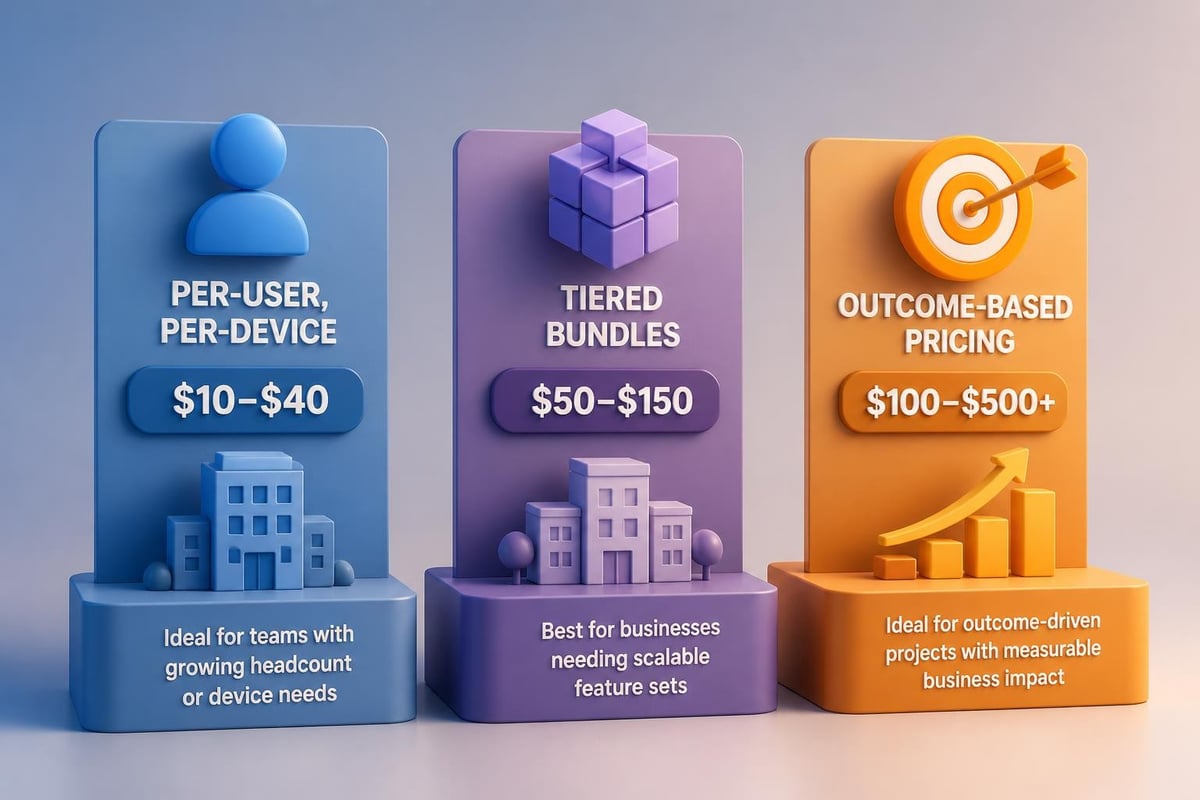
MSPs structure their fees in several distinct ways, each suited to different business sizes and operational needs. The per-user model charges a flat monthly rate for each employee receiving IT support-typically ranging from $75 to $250 per user in 2026, depending on the breadth of services. This approach offers straightforward budgeting and scales linearly as headcount grows, making it popular for small to mid-sized companies with predictable staffing.
Per-device pricing bills according to the number of endpoints (workstations, servers, mobile devices) under management. Rates often fall between $50 and $150 per device monthly, with servers commanding premium tiers. This model suits organizations with fluctuating headcount but stable equipment counts, such as seasonal businesses or those employing contractors.
Many providers bundle services into bronze, silver, and gold tiers, each offering escalating levels of support, response time, and included features. Entry-level tiers might cover basic helpdesk and patch management, while premium packages add 24/7 monitoring, cybersecurity services, and strategic IT consulting. According to TechTarget’s MSP primer, tiered models simplify vendor comparison and allow businesses to right-size services without negotiating custom scopes.
Philippine enterprises considering comprehensive IT solutions often prefer tiered structures because they can start conservatively and upgrade as digital transformation matures. A manufacturer in Metro Manila, for instance, might begin with essential monitoring and ticketing in bronze, then migrate to silver for enhanced security and backup as production systems expand.
Emerging in 2026 is the value-based or outcome-focused pricing model, where fees are tied to measurable business outcomes-uptime percentages, mean time to resolution (MTTR), or cost avoidance metrics. TSIA research on managed-services pricing highlights that this shift from cost-based to value-based frameworks aligns vendor incentives with client success, driving higher service quality and innovation.
Under outcome-based contracts, a provider might guarantee 99.9% system availability and receive performance bonuses for exceeding targets or incur penalties for missed SLAs. While more complex to administer, these arrangements are gaining traction among enterprises with mission-critical operations who demand demonstrable ROI from their IT investments.
Several variables shape the final cost of managed IT engagements, often creating wide spreads between provider quotes for seemingly similar scopes.
Basic helpdesk and remote monitoring occupy the lower end of pricing, while comprehensive packages including cybersecurity, compliance management, cloud migration, and strategic planning command significantly higher fees. For businesses in regulated industries-healthcare, finance, logistics-compliance-related services (GDPR, HIPAA, local data privacy laws) add 15–30% to baseline costs.
Organizations requiring specialized hardware support, such as enterprise servers or advanced network firewalls, should expect premium rates due to the technical expertise and certifications needed to manage these platforms.
Pricing varies by region. Metro Manila providers typically charge higher rates than provincial MSPs, reflecting differences in labor costs, competitive density, and client budgets. BestITMSPs industry benchmarking shows that Southeast Asian markets-including the Philippines-see per-user rates 20–40% below U.S. averages, yet local businesses benefit from providers who understand regional connectivity challenges and regulatory nuances.
| Pricing Factor | Impact Range | Notes |
|---|---|---|
| Service scope | 40–200% variance | Helpdesk vs. full-stack managed security |
| Geography | 20–40% variance | Metro vs. provincial, local vs. international vendors |
| Contract term | 10–20% discount | Multi-year commitments reduce monthly fees |
| SLA stringency | 15–30% premium | 24/7 response, guaranteed uptime |
| Customization | 25–50% markup | Bespoke integrations, industry-specific workflows |
Longer commitments-two or three years-typically unlock discounts of 10–20% compared to month-to-month or annual agreements. However, businesses must weigh savings against flexibility. Forrester’s 2025 technology services report notes that buyers increasingly demand mid-contract review clauses and scalability provisions to adjust service levels as business needs evolve.
Understanding market rates helps buyers identify competitive proposals and avoid overpaying for standard services.
Based on aggregated industry surveys, typical it managed services pricing falls into these brackets:
Avasant’s managed-services pricing trends reveal a shift toward hybrid models combining fixed monthly fees for core services with variable charges for project work, cloud consumption, or user overage-providing predictability while accommodating growth.
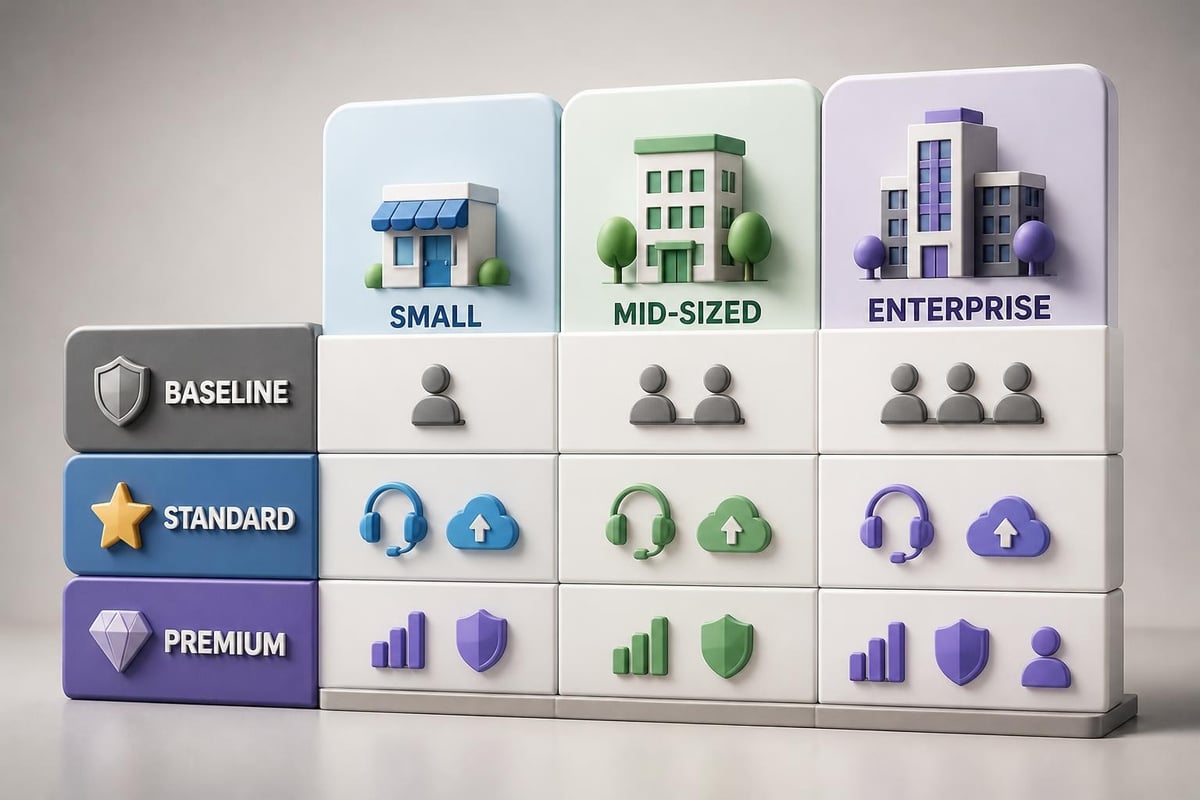
Understanding deliverables is essential for apples-to-apples comparisons:
Entry-level packages ($75–$125 per user):
Mid-tier packages ($125–$175 per user):
Premium packages ($175–$250+ per user):
Businesses investing in modern collaboration tools-such as wireless headsets for hybrid work-or upgrading to Wi-Fi 7 infrastructure should verify that hardware support and configuration services are explicitly included or clearly priced as add-ons.
When comparing it managed services pricing from multiple vendors, go beyond the headline monthly fee.
Calculate TCO by summing recurring fees, onboarding charges, implementation costs, and potential overage fees over the contract lifetime. Some providers advertise attractive per-user rates but bury significant setup fees or charge extra for essential services like data migration or emergency support outside core hours.
Ask vendors to provide detailed breakdowns:
Strong SLAs define performance standards and remedies for non-compliance. Review response times, resolution targets, uptime guarantees, and escalation procedures. CompTIA’s MSP buyer guidance recommends negotiating credits or service fee reductions if the provider misses SLA commitments repeatedly.
Critical SLA components to evaluate:
Business growth should not trigger excessive repricing. Confirm how the provider handles user additions, technology refreshes, and seasonal fluctuations. Fixed per-user models offer predictable scaling, while tiered packages may require tier upgrades when adding significant headcount.
For companies offering computer leasing or rent-to-own programs, managed services contracts should accommodate equipment turnover and seamless onboarding of new hardware without administrative friction or surprise fees.
Armed with benchmarks and clear requirements, businesses can negotiate better terms and pricing.
Providers prefer long-term, stable revenue. Offering a two- or three-year commitment in exchange for 10–15% discounts is common. Similarly, bundling multiple locations or divisions under a single contract often unlocks volume pricing.
Negotiation tactics:
Ambiguity leads to conflict. Ensure contracts explicitly list included services, excluded items, and processes for scope changes. Common exclusions-application-specific troubleshooting, physical hardware repairs, telecom circuit management-should be documented with alternative support options or add-on pricing.
KPMG’s managed-services outlook emphasizes that buyers increasingly demand transparency around margin and cost structures, particularly for pass-through expenses like cloud subscriptions or third-party software licenses. Request itemized invoices and reserve audit rights to verify billing accuracy.

Contracts should protect both parties but allow orderly transitions. Negotiate reasonable notice periods (60–90 days), offboarding assistance at no additional charge, and data portability guarantees. Avoid auto-renewal clauses without advance notice windows, and ensure you retain ownership of all documentation, configurations, and intellectual property developed during the engagement.
Some organizations blend multiple frameworks to match unique operational realities.
A common hybrid combines a monthly per-user fee for ongoing support and monitoring with hourly or project-based rates for strategic initiatives-cloud migrations, ERP implementations, network redesigns. This structure balances predictable operating costs with flexibility for episodic capital investments.
For example, a logistics company might pay $120 per user monthly for core IT management and separately engage the same MSP at $150–$200 per hour for warehouse automation projects.
As workloads shift to cloud platforms, some providers incorporate usage-based pricing for infrastructure-as-a-service (IaaS) and platform-as-a-service (PaaS) components. Monthly fees cover management and optimization while compute, storage, and bandwidth costs pass through at actual consumption levels.
Guidehouse’s managed services guide notes that transparency is essential-clients should receive detailed usage reports and recommendations to optimize spending without surprise bills.
For large enterprises or those with highly specialized environments, dedicated technician or resident engineer models allocate specific personnel (full-time or part-time) to the client. Pricing resembles staff augmentation-annual salaries of $60,000–$120,000 per engineer, fully loaded with benefits, training, and overhead-but the provider handles hiring, retention, and backfill.
This approach suits businesses requiring deep institutional knowledge and on-site presence, such as manufacturing plants or research facilities.
Selecting the right pricing model is only the beginning. Ongoing management ensures value realization.
Schedule quarterly business reviews to assess SLA compliance, review ticket trends, and discuss strategic roadmap alignment. Use these sessions to identify underutilized services, negotiate scope adjustments, and address emerging needs before they become crises.
Metrics to track:
As business operations mature, service needs evolve. A startup may begin with basic helpdesk but require advanced security as it handles customer data or expands internationally. Conversely, companies stabilizing post-growth may downgrade from premium to standard tiers to control costs.
Work with your provider to adjust service levels annually based on actual usage patterns. If your team rarely uses after-hours support, renegotiate to business-hours coverage and reallocate savings toward proactive security initiatives.
Align managed services contracts with hardware refresh cycles to simplify procurement and reduce administrative burden. Providers offering bundled hardware-as-a-service (HaaS) or leasing programs-such as those for Apple devices or display connectivity solutions-can streamline IT operations and improve cash flow predictability.
Local market dynamics influence both pricing and service delivery expectations.
Philippine businesses contend with variable internet reliability, especially outside major metros. Ensure your MSP has strategies for remote support under bandwidth constraints, local data center partnerships for faster access, and backup communication channels.
Providers should demonstrate experience with local ISPs, redundant connectivity solutions, and disaster recovery plans accounting for regional risks (typhoons, power outages).
Data privacy laws and industry regulations add complexity. MSPs serving Philippine clients should understand Data Privacy Act (DPA) obligations, secure data handling practices, and reporting requirements. Compliance-focused services may add 10–20% to baseline pricing but are essential for avoiding penalties and protecting customer trust.
Effective IT support requires clear communication. While many Philippine MSPs offer English-language support, verify that technicians understand local business practices, time zones, and cultural norms. Misaligned expectations around urgency, escalation, or problem ownership can undermine even well-priced contracts.
Navigating it managed services pricing requires balancing cost predictability with service quality, scalability, and strategic alignment. By understanding the nuances of per-user, per-device, tiered, and outcome-based models-and benchmarking proposals against industry standards-businesses can secure partnerships that reduce downtime, enhance productivity, and support long-term growth. REDCHIP IT SOLUTIONS INC. provides comprehensive IT solutions, including computer leasing, rent-to-own services, and professional IT consultancy tailored to Philippine businesses seeking scalable, reliable support. Whether you're evaluating your first managed services agreement or renegotiating an existing contract, REDCHIP IT SOLUTIONS INC. can help you design an IT strategy that aligns technology investments with business outcomes.